


If you've been looking for help answering the phone, you've probably come across three terms: AI receptionist, virtual assistant and call answering service.
They're often used as if they mean the same thing. They don't, and picking the wrong one means paying for something designed to solve a different problem.
Call answering service: a person, somewhere else
A call answering service is a team of people, usually in a shared call centre, answering your phone from a script you give them.
You get a real person on the line, which is the appeal. It's also the limit. They're working from your script, not your systems, so anything beyond a simple message or a basic question comes back to you as a message to which you need to respond.
Virtual assistant: a person, part-time
A virtual assistant is usually a remote assistant who handles a mix of admin for you, sometimes including calls. They're rarely full-time and they're not on call around the clock.
That makes them great for taking care of day-to-day tasks, but they're not built to be the thing that stops you missing calls.
AI receptionist: software that handles the call, not just the message
An AI receptionist, like Aila, works differently. It isn't a person reading a script or a chatbot sending canned replies.
It understands what the caller needs, checks real information like availability or account details, and takes immediate action, such as booking an appointment or updating a record. The moment something needs a judgement call, it hands over to one of your team. No shift patterns, no sick days, no gaps in the script.
Which one fits your business?
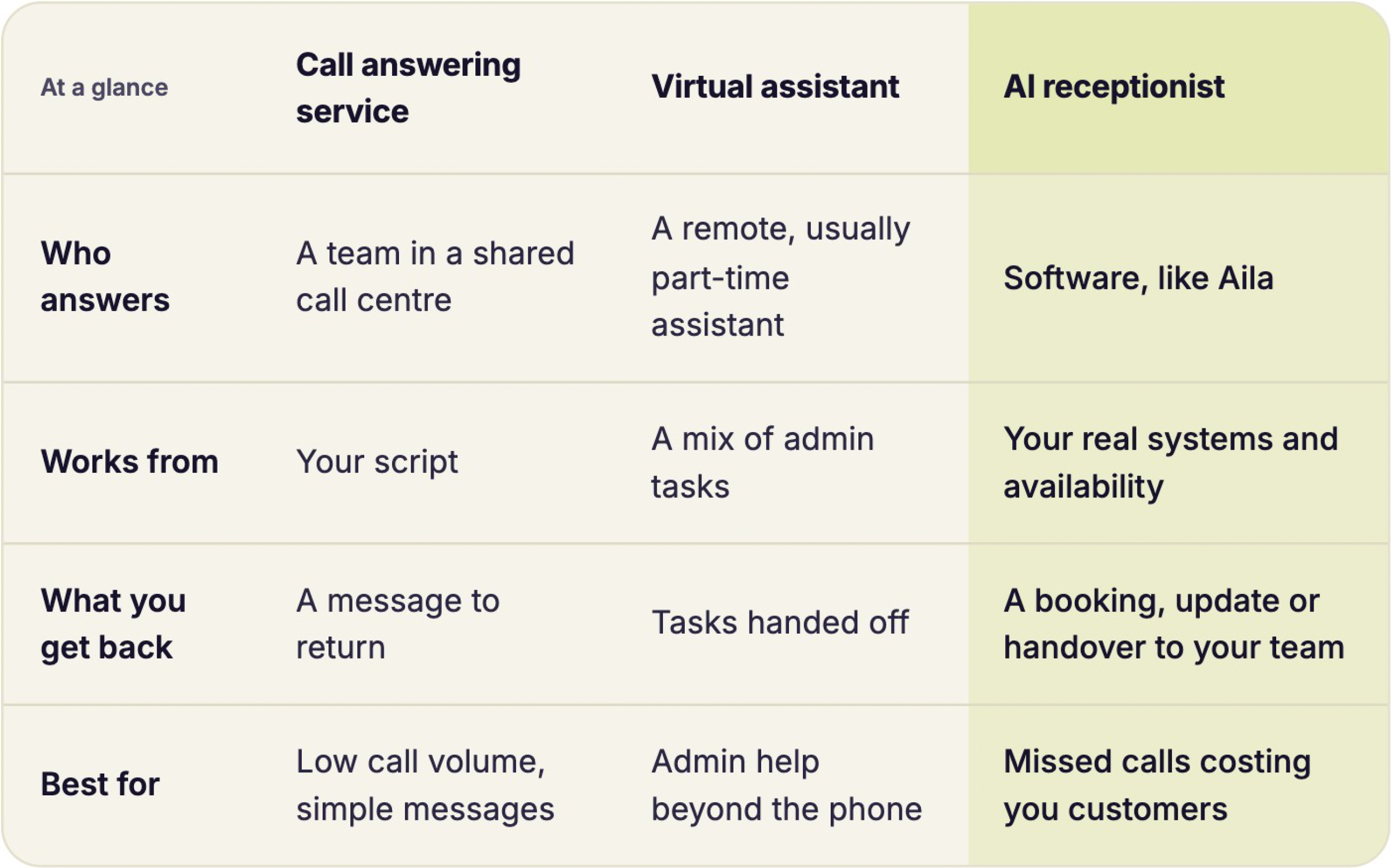
It comes down to one question: do you need someone to take a message, or something that can deal with the call?
Keep reading
All articles
