


How quickly does your business answer customer enquiries? It’s probably something you can measure fairly easily.
But here’s a more interesting question: how often do customers actually get the answer they need?
Because when it comes to AI customer service, speed alone doesn’t necessarily tell you much about the quality of the experience. A chatbot might respond in seconds. An AI agent might handle hundreds of enquiries without employee involvement. But if customers have to get back in touch because their problem wasn’t resolved, how much value has that automation really delivered?
That’s why first-contact resolution should be a central consideration in any AI customer experience strategy. And the latest UK customer satisfaction research makes a compelling case for getting things right first time.
What does the UKCSI say about right first time customer service?
83.2%
Of customer experiences were right first time, the highest proportion recorded in the index
78.2
Overall UK customer satisfaction, out of 100
+2.1
Points higher than January 2025
Source: Institute of Customer Service, UK Customer Satisfaction Index, January 2026.
According to the January 2026 UK Customer Satisfaction Index, published by the Institute of Customer Service, 83.2% of customer experiences were right first time. That’s the highest proportion recorded in the index.
The research also found that overall UK customer satisfaction reached 78.2 out of 100, increasing by 2.1 points compared with January 2025. It’s encouraging progress, particularly as businesses continue navigating rising customer expectations and pressure to manage costs.
But there’s a valuable lesson in those results. Customers don’t simply want a fast response. They want their questions answered accurately, their problems resolved and a straightforward experience.
Right first time customer service is about achieving that outcome without unnecessary follow-ups, corrections or repeated conversations. And that should be just as important for AI as it is for human employees.
What is first-contact resolution in AI customer service?
First-contact resolution (FCR) measures the proportion of customer enquiries resolved during the initial interaction, without the customer needing to contact the business again about the same issue.
It’s one of the most useful customer service KPIs because it connects operational performance with the customer’s experience. For example, an AI agent might successfully answer a question about opening hours. If the customer gets the information they need, that’s a straightforward resolution.
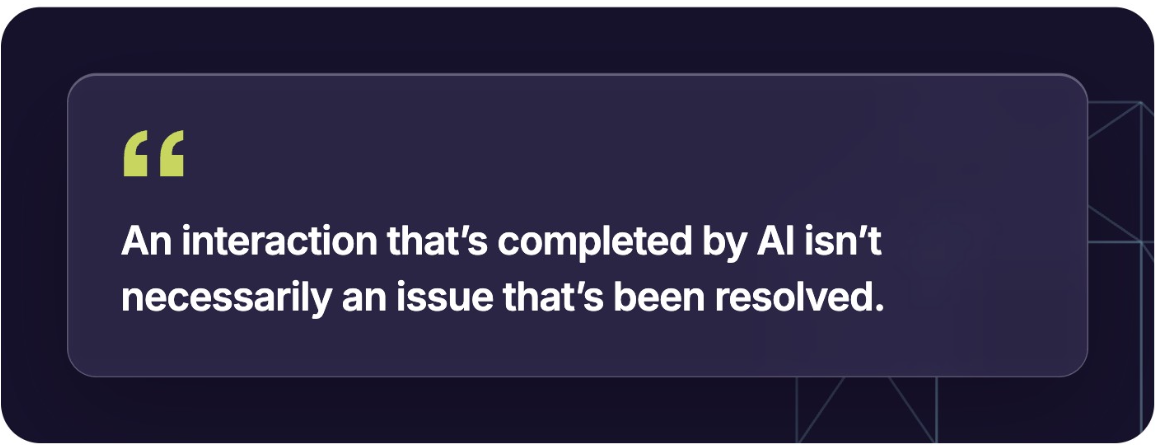
But imagine the same AI assistant gives someone an incorrect delivery date. The conversation ends, and the system records the enquiry as completed. Two days later, the customer contacts the business again because their parcel hasn’t arrived. The original interaction might have been quick, but it wasn’t particularly successful.
This distinction becomes increasingly important as businesses introduce more sophisticated AI customer service capabilities. Measuring how often AI responds is relatively easy. Understanding whether the response genuinely resolved the customer’s need takes a little more work.
Why automation rates don’t tell the whole story
There’s nothing wrong with tracking automation rates. Knowing how many routine enquiries AI handles can help businesses understand workload reductions, capacity improvements and potential cost savings. But automation without accuracy can create new problems.
This is why reducing repeat contacts should be considered alongside automation and response times.
Four ways to improve first-contact resolution with AI
Give AI access to accurate information. Even sophisticated AI systems need reliable information to provide useful answers. That means access to current product details, service information, policies and relevant customer records where appropriate. If the underlying information is incomplete or outdated, AI may struggle to resolve enquiries accurately, so review it regularly, particularly when products, prices or processes change.
Let AI resolve routine enquiries end to end. A customer might want to check an order, change an appointment or update their details. Where the appropriate integrations and permissions are in place, AI can help complete these tasks without requiring customers to switch channels or wait for an employee. Focus AI’s Virtual Agent is designed to handle routine interactions across voice and chat, supporting customers with relevant information and connected workflows.
Recognise when human support is needed. Sometimes the best route to resolving an enquiry is transferring it to someone with the right knowledge or authority, because the issue is unusually complicated, requires an exception or involves sensitive personal circumstances. Crucially, AI should preserve relevant conversational context so the employee can continue without asking the customer to start again.
Learn from unresolved conversations. Rather than relying only on individual complaints or random call samples, teams can examine recurring enquiries and identify where customers are struggling. Conversational Intelligence helps businesses analyse interactions to identify trends, assess customer sentiment and uncover opportunities to improve performance.
A well-timed handoff can be far more valuable than an unsuccessful attempt to keep
the conversation automated. And repeated questions about a particular service might
indicate that information needs updating, while multiple follow-up calls about the same
issue could highlight a gap in an existing AI workflow.
Which customer service KPIs should sit alongside FCR?
First-contact resolution is valuable, but it works best as part of a broader set of performance measures. Businesses should also consider:
Together, these customer service KPIs offer a more complete picture of AI performance. A high AI resolution rate sounds positive, but if customer satisfaction is falling or repeat contacts are increasing, something may need attention. Likewise, an increase in human escalations isn’t necessarily a problem if those transfers help resolve complicated enquiries properly.
Build your AI customer experience strategy around outcomes
It’s tempting to start an AI roadmap by asking how many enquiries can be automated. A more useful approach is to identify where customers are currently struggling to get the answers they need.
Those are the opportunities worth prioritising. The UKCSI’s right-first-time findings reinforce why this matters. Customer satisfaction improves when businesses understand what customers need and deliver it effectively. AI can play an important role in making that happen, provided success is measured by the quality of the outcome.
Because the best customer experience is often the one that doesn’t require a second conversation.
Keep reading
All articles